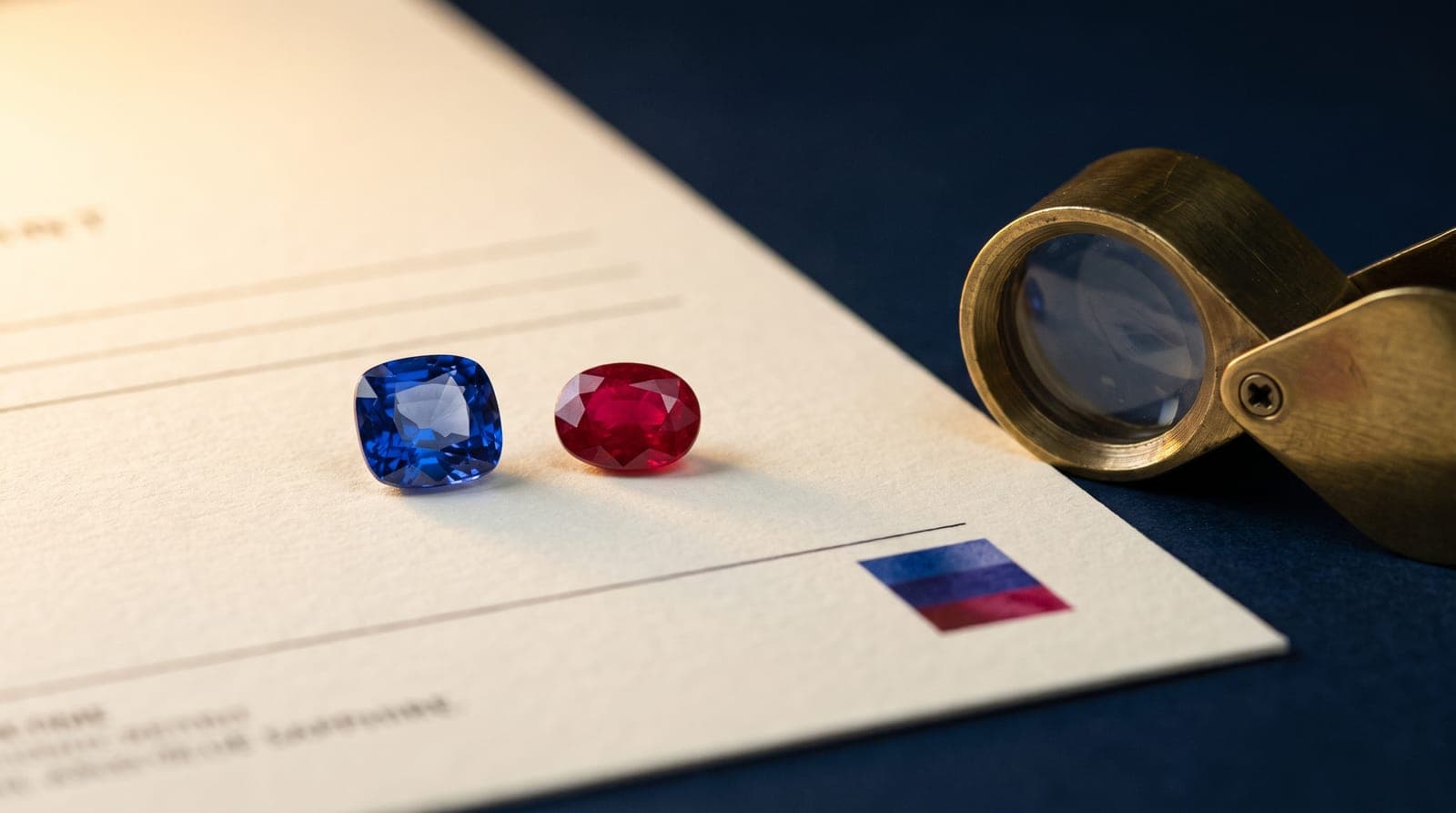
Why Reading the Report Matters as Much as Having One
A laboratory report is only useful if you can interpret it. In the wholesale trade, the difference between "no indications of heating" and "indications of heating" can mean a multiple of the price — and a buyer who misreads a treatment line, or assumes an origin opinion is a guarantee, exposes themselves to costly disputes. Once you have chosen which lab to trust (our guide to GIA vs AIGS vs GIT certification covers that decision), the next skill is reading the report itself.
A gemstone lab report is defined as a formal document in which a gemological laboratory records a stone's identity, measured weight and dimensions, color and clarity characteristics, and any detectable treatments — along with, on some reports, an opinion on geographic origin. Every major lab (GIA, AIGS, GIT, GRS and others) organizes this information into the same core sections, even when the exact wording differs.
This guide walks through those sections in the order they typically appear, explains the treatment language that drives value, and covers the two questions buyers ask most: why labs sometimes disagree, and what to do when they do.
The Core Sections of a Report
Most colored-stone reports present the same fields. Read them in this order:
| Report number & date | A unique ID that ties the document to one stone. Always verify it is current and matches the seller's reference. |
| Object / identification | The species and variety — e.g. 'Natural Sapphire' or 'Natural Ruby (Corundum).' The word 'natural' is critical: its absence can signal synthetic or treated material. |
| Weight | Carat weight to two decimal places, measured on the loose stone. |
| Measurements | Length × width × depth in millimetres. These let you confirm the report belongs to the stone in your hand. |
| Shape & cutting style | e.g. 'Oval mixed cut.' Describes outline and faceting, not quality. |
| Color | A descriptive color name (and, on some reports, a trade term such as 'royal blue' or 'pigeon's blood'). |
| Comments / treatment | The most important line for value — see below. |
| Origin (optional) | An opinion on geographic origin, present only when requested and determinable. |
The single most valuable habit is to match the measurements and weight on the report to the stone itself. A report only certifies the specific stone it describes; dimensions are how you prove the document and the gem belong together.
Treatment Disclosure: The Line That Moves the Price
For sapphires and rubies, treatment status is usually the largest single price factor after color. Laboratories describe treatment in the comments section, and the conventions vary slightly between labs — so read the words, not just a code.
For corundum (sapphire and ruby), reports generally fall into a hierarchy:
Treatment notations for corundum, simplified. Exact phrasing differs by laboratory — confirm with the issuing lab when in doubt.
| Report wording (typical) | What it means | Effect on value |
|---|---|---|
| No indications of heating | No gemological evidence the stone was heated | Highest — commands an unheated premium |
| Indications of heating | Standard heat treatment detected | Baseline for fine heated goods |
| Heating with residue / flux healing | Heat plus fracture healing or residue in fissures | Lower than simple heating |
| Clarity-enhanced / fracture-filled | Cavities or fractures filled (glass, resin) | Lowest tier; must always be disclosed |
Two cautions:
- Wording is not standardized across labs. One lab's "no indications of heating" is another's "unheated," and emerald reports use a separate scale (none / minor / moderate / significant clarity enhancement). Our sapphire heat treatment guide breaks down the corundum codes in detail.
- Absence of a comment is not the same as "no treatment." If a report is silent on treatment, ask the lab what their silence means — some omit a line only when treatment is undetectable, not when it is absent.
Origin: An Opinion, Not a Guarantee
When a report includes a country of origin, treat it as a qualified expert opinion. Labs reach it by comparing a stone's inclusions and trace-element chemistry against a reference collection — powerful, but not infallible. Reputable reports word origin carefully, and for borderline stones a lab may state a "probable" origin or decline to issue one. A Burmese or Kashmir attribution can carry a steep premium, so verify that the origin language is definitive rather than tentative before paying for it. For how origin interacts with pricing, see our ruby price per carat guide.
Why Two Labs Can Disagree
Buyers are often unsettled when two reports on the same stone do not match. Usually the explanation is mundane:
- Weight and dimensions can differ by a rounding increment (±0.01-0.02ct) simply from re-measurement. This is normal.
- Treatment calls can differ at the margins — one lab may read faint evidence as "indications of heating" where another sees none. This is where lab choice and reputation matter most.
- Origin opinions can differ because each lab compares against its own reference database.
When a genuine conflict exists, confirm both reports describe the same stone (match the dimensions first), then weight the more authoritative and more recent report, and consider a third opinion to break a tie. Whatever you conclude, disclose the discrepancy to your buyer — undisclosed conflicts are how reputations are lost.
A Practical Reading Checklist
Before you accept any report as part of a transaction:
- Confirm the report number and date are current.
- Match the weight and measurements to the actual stone.
- Read the identity line — verify "natural" appears where it should.
- Read the treatment comment word-for-word; if unclear, query the lab.
- Treat any origin line as an opinion and check whether it is definitive or "probable."
- For high-value stones, confirm the report is verifiable on the laboratory's online database.
Reading a report fluently turns certification from a piece of paper into genuine protection. If you are still deciding which laboratory's report to request in the first place, start with our comparison of GIA, AIGS, and GIT, and for the synthetic-detection side of authentication, see how to spot synthetic rubies.