Why Synthetic Ruby Identification Matters for B2B Buyers
Synthetic rubies have existed since Auguste Verneuil perfected his flame-fusion process in 1902 — making ruby the first gemstone to be commercially synthesized. Today, multiple production methods create synthetic rubies that range from obviously artificial to nearly indistinguishable from natural material without laboratory equipment.
A synthetic ruby is defined as a laboratory-grown crystal that has the same chemical composition (Al2O3 with Cr trace element), crystal structure (trigonal/hexagonal), and physical properties as natural ruby. It is a real ruby in every chemical and physical sense — the distinction is origin, not substance.
For wholesale buyers, dealers, and jewelry manufacturers sourcing rubies, the ability to identify synthetics is not optional — it is a core competency that protects your business, your reputation, and your clients. A single undisclosed synthetic in a parcel of natural rubies can destroy a business relationship and invite legal liability. Knowing the inclusions natural rubies typically show — silk, crystals, healed fractures, covered in our ruby buying guide — is the essential foundation for this detection work.
Synthetic Ruby Production Methods
Understanding how synthetic rubies are made is the foundation of identifying them. Each production method leaves characteristic signatures that trained gemologists use for identification.
Flame Fusion (Verneuil Process)
The oldest and most common method. Powdered aluminum oxide with chromium is melted in an oxyhydrogen flame and allowed to crystallize on a rotating pedestal, forming a teardrop-shaped "boule." This process is fast and inexpensive — a single boule can be grown in hours.
Key identifiers:
- Curved growth lines (striae) visible under magnification — the single most diagnostic feature
- Spherical gas bubbles, often in clouds or strings
- Unnatural color uniformity
- No natural mineral inclusions
Difficulty to detect: Low. These are the easiest synthetics to identify with basic gemological tools.
Flux Melt Process
Aluminum oxide is dissolved in a chemical flux (typically lead oxide, lithium molybdate, or bismuth oxide) at high temperatures, then allowed to crystallize slowly as the solution cools. This process takes weeks to months and produces crystals that more closely resemble natural ruby.
Key identifiers:
- Flux inclusions — wispy, veil-like features that can superficially resemble natural inclusions
- Residual flux particles (often platinum or metallic platelets from the crucible)
- Straight growth features but with patterns distinct from natural ruby
- Unusual UV fluorescence patterns
Difficulty to detect: Moderate. Requires gemological training and experience.
Hydrothermal Process
Ruby is grown from a water-based solution at high temperature and pressure — conditions that more closely mimic natural ruby formation. This produces the most natural-looking synthetic rubies.
Key identifiers:
- Chevron-shaped or zigzag growth patterns under immersion
- Seed crystal remnants
- Nail-head or breadcrumb-like inclusions
- Trace element profiles that differ from natural ruby (detectable by advanced spectroscopy)
Difficulty to detect: High. Often requires laboratory instrumentation for definitive identification.
Czochralski (Pulling) Method
A seed crystal is dipped into molten aluminum oxide and slowly pulled upward as the melt crystallizes on it. Used primarily for industrial and optical applications but occasionally appears in the gem market.
Key identifiers:
- Similar to flame-fusion in many respects
- Curved striae may be present
- Gas bubbles possible
- Very clean — suspiciously inclusion-free
| Method | Production Time | Cost | Detection Difficulty | Market Frequency |
|---|---|---|---|---|
| Flame Fusion | Hours | Very low ($1-5/ct) | Easy — curved striae, bubbles | Very common |
| Flux Melt | Weeks to months | Moderate ($20-100/ct) | Moderate — requires training | Common in fine sizes |
| Hydrothermal | Weeks to months | Moderate to high | Difficult — may need lab | Less common |
| Czochralski | Hours to days | Moderate | Easy to moderate | Rare in gem trade |
Visual Identification Techniques
These techniques can be performed with basic gemological equipment — a 10x loupe, a penlight, and ideally a gemological microscope.
Step 1: Initial Impression
Before reaching for any tools, evaluate the stone's overall appearance. Ask yourself:
- Is the color suspiciously perfect? Natural rubies almost always show some color variation — subtle zoning, slight differences in saturation across the stone. A ruby with absolutely uniform, electric-red color, particularly in a large size (over 2 carats), should raise immediate suspicion.
- Is the clarity too good? Natural rubies are Type II gemstones — they virtually always contain inclusions. A large, vivid ruby that appears completely clean even under 10x magnification is statistically more likely to be synthetic than natural.
- Is the price too good? A 3-carat vivid red ruby offered at $200 per carat is not a bargain — it is almost certainly synthetic or treated beyond acceptable standards.
Step 2: Magnification (10x Loupe or Microscope)
Under magnification, look systematically for:
Curved growth lines: The most diagnostic feature of flame-fusion synthetics. Natural rubies display straight, angular growth zoning that follows the hexagonal crystal structure. Flame-fusion rubies show curved lines that follow the shape of the boule. View the stone from multiple angles and under different lighting to detect subtle striae.
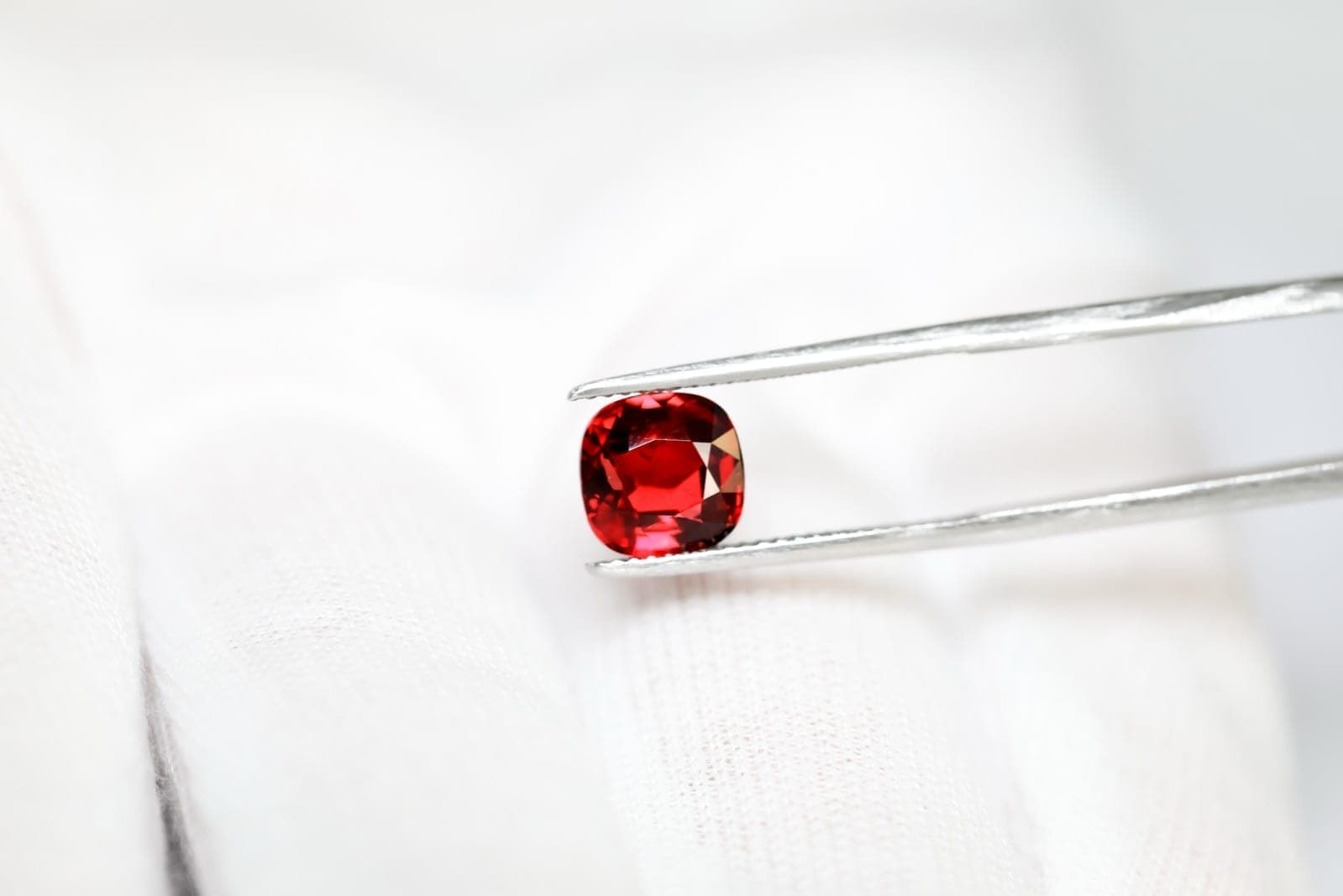
Gas bubbles: Spherical gas bubbles — either isolated or in clouds — are characteristic of flame-fusion and some Czochralski synthetics. Natural rubies do not contain spherical gas bubbles. (Note: do not confuse rounded crystal inclusions in natural rubies with gas bubbles — crystal inclusions are typically not perfectly spherical and often have crystal faces visible under high magnification.)
Flux remnants: In flux-melt synthetics, look for wispy, cloud-like features that differ from natural silk. Flux inclusions often have a characteristic "fingerprint" pattern but with a different texture than natural healing features. Metallic platelets — tiny reflective flakes from the crucible material — are diagnostic of flux-melt growth.
Natural inclusion signatures: The presence of natural mineral inclusions (rutile silk, crystal inclusions of calcite, apatite, or other minerals) is strong evidence of natural origin. Synthetics do not contain these natural mineral guests.
Step 3: Immersion Testing
Placing the stone in a liquid with a similar refractive index (methylene iodide or diiodomethane for rubies) allows you to see internal growth patterns more clearly by reducing surface reflections.
Under immersion:
- Natural rubies show straight, angular color zoning following the hexagonal crystal structure
- Flame-fusion synthetics show curved growth bands
- Flux-melt synthetics may show irregular growth patterns with flux remnants
- Hydrothermal synthetics show chevron or zigzag growth patterns
Step 4: UV Fluorescence
While not definitive on its own, UV fluorescence provides supporting evidence:
- Natural Burmese rubies: Strong red fluorescence under long-wave UV (low iron)
- Natural Mozambique/Thai rubies: Weaker fluorescence (higher iron)
- Flame-fusion synthetics: Very strong red fluorescence (very low iron, no iron at all in many cases)
- Flux-melt synthetics: Variable, depending on the flux composition
A ruby that fluoresces extremely strongly under UV — more intensely than any natural ruby you have seen — may be synthetic. However, UV testing alone cannot confirm or rule out synthetic origin.
| Feature | Natural Ruby | Flame Fusion | Flux Melt | Hydrothermal |
|---|---|---|---|---|
| Growth Lines | Straight, angular | Curved (diagnostic) | Straight but unusual pattern | Chevron/zigzag |
| Inclusions | Mineral crystals, silk, fingerprints | Gas bubbles | Flux veils, metallic platelets | Seed remnants, breadcrumbs |
| Color Zoning | Angular, hexagonal | Curved bands | Irregular patches | Planar, regular |
| UV Fluorescence | Variable by origin | Very strong red | Variable | Variable |
| Clarity | Usually included | Often very clean | Moderate — flux inclusions | Often clean |
Advanced Laboratory Techniques
When visual examination is inconclusive — particularly with high-quality flux-melt and hydrothermal synthetics — advanced instrumental techniques provide definitive answers.
FTIR Spectroscopy
Fourier Transform Infrared spectroscopy analyzes how the ruby absorbs infrared light. Natural and synthetic rubies show different absorption patterns in the 3000-3500 cm-1 region related to water and hydroxyl content. Hydrothermal synthetics, grown in water-based solutions, often show distinctive water-related absorption features.
Trace Element Analysis (LA-ICP-MS or EDXRF)
Natural rubies contain a complex cocktail of trace elements acquired from their geological environment — iron, titanium, vanadium, gallium, and others in specific ratios characteristic of their origin. Synthetic rubies have much simpler trace element profiles because the growth chemicals are controlled. This technique can distinguish natural from synthetic with very high confidence.
Photoluminescence Spectroscopy
The fluorescence emission spectrum of a ruby, when analyzed in detail, can reveal differences between natural and synthetic material. Chromium emission peaks at specific wavelengths show subtle differences in their fine structure depending on the growth environment.
Common Scenarios in the Wholesale Market
Flame-Fusion Synthetics in Calibrated Parcels
The most common deception in the wholesale market is mixing flame-fusion synthetic rubies into parcels of natural calibrated goods. Because individual stones in a calibrated lot may be worth only $10-100, the cost of certifying each stone individually is prohibitive. Defense strategy: random sampling with magnification, familiarity with the inclusion signatures of the origin you are buying, and sourcing from trusted suppliers with established track records.
Flux-Melt Synthetics Presented as Fine Natural
Higher-quality flux-melt synthetics, sometimes with deliberate inclusions to mimic natural features, are occasionally presented as fine natural rubies in the 1-5 carat range. These require careful gemological examination and often laboratory confirmation. Defense strategy: certify all stones above 1 carat from reputable labs.
Composite and Glass-Filled Material
While technically not synthetic, glass-filled rubies (natural ruby material with extensive lead-glass filling of fractures) represent another identification challenge. These stones are natural ruby at their core but may be 50%+ glass by volume. Under magnification, look for: blue-orange flash effect in fractures, gas bubbles within the glass fill, and unusual surface texture where glass meets ruby. These must be disclosed and are valued far below untreated or conventionally heated rubies.
Building Your Detection Capability
For B2B operations, we recommend building a systematic approach to synthetic detection:
- Invest in equipment: At minimum, a quality 10x loupe, a gemological microscope, and a UV light source. Total investment: $500-2,000 for basic but adequate equipment.
- Train your team: Ensure anyone evaluating rubies can identify curved striae, gas bubbles, and flux inclusions. GIA and AIGS offer courses in gemstone identification.
- Establish lab relationships: Have accounts with at least one reputable lab for certification of significant stones.
- Know your supply chain: The best protection against synthetics is buying from established, reputable suppliers with verifiable sourcing chains.
- Document everything: Photograph inclusions and maintain records of examination findings for all significant purchases.
Understanding how pigeon blood rubies are graded and valued makes synthetic detection even more critical — the higher the claimed value, the greater the incentive for misrepresentation. Building a relationship with a supplier who has verifiable sourcing chains is ultimately your strongest protection; learn more about what to look for in our Thailand sourcing guide.
Protecting your business from synthetic rubies starts with knowledge and ends with trusted sourcing relationships. Browse our certified natural rubies or reach out to discuss your sourcing needs.