What "Melee" Means in Sapphire Work
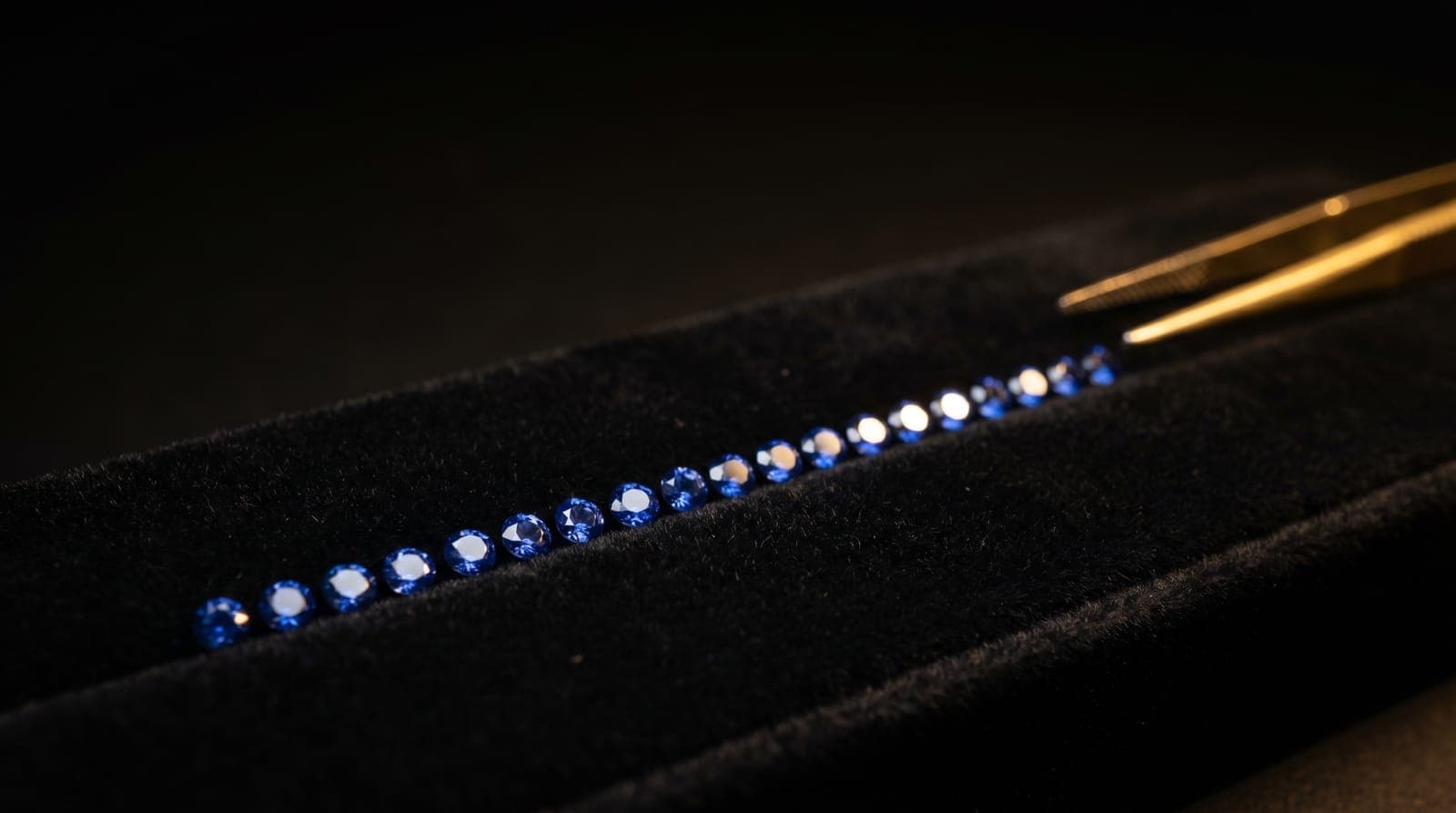
Melee describes small calibrated stones, typically 1.0mm to 3.0mm, sold and used as accent material rather than as center stones. The term is a category distinction, not just a size one — melee is priced, sorted, and handled differently from larger goods.
A 6mm round sapphire is an individual stone. It is measured, weighed, graded, and often sold with its own price. A 1.75mm round sapphire is part of a parcel. It lives and dies by the consistency of the group it ships with. Nobody grades a single 1.75mm stone; the grade applies to the lot.
Melee shows up in pavé fields, halos around center stones, eternity bands, bezel accents, and the shoulders of three-stone rings. Anywhere a designer wants continuous color without pulling the eye away from a focal stone, melee is doing the work.
For a broader introduction to how calibration tolerances are defined across all sizes, see our gemstone calibration guide. This post focuses specifically on what changes when the stones get small.
Why Calibrated Matters for Pavé
Pavé settings are machined to specification. A 1.75mm seat is cut for a 1.75mm stone — with perhaps 0.05mm of working tolerance in the setting itself. Drop a 1.85mm stone into that seat and the setter either forces it (risking chipping) or reshapes the seat (adding hours of labor). Drop a 1.65mm stone in and the prongs close over a gap, leaving the stone loose or sitting crooked.
Multiply this across a single halo of eighteen stones, and a parcel with 0.2mm variance creates eighteen individual problems. Multiply again across a production run of two hundred pieces, and you have a quality control disaster.
This is why calibrated melee costs more than unsorted goods, and why the premium is worth paying. Labor time on the setter's bench is the expensive part of jewelry production. Stones that fit their seats the first time are cheaper in finished-piece terms, even when the per-carat price looks higher on the invoice.
Standard Melee Size Brackets
The following are the sizes most commonly requested by production manufacturers. A supplier worth working with should have these in stock or be able to calibrate to them on short notice.
Round Melee
- 1.0mm — rare, used in micro-pavé on watch bezels and high-end jewelry
- 1.25mm — fine pavé, small halos
- 1.5mm — the most common "small" melee size, broadly used in halos and accent rows
- 1.75mm — transition size, used where 1.5mm reads too delicate and 2.0mm too prominent
- 2.0mm — standard halo and eternity band size
- 2.25mm — common in three-stone ring shoulders
- 2.5mm — larger accent work, bezel accents, smaller solitaire halos
- 2.75mm — approaching the edge of what is still considered melee
- 3.0mm — upper bound of melee; beyond this, stones are typically individually sorted
Fancy Shape Melee
Production also uses non-round melee, though in smaller volume:
- 1.5×2mm oval — side stones for smaller three-stone settings
- 2×3mm pear — drop-shaped accents and shoulders
- 1.5×3mm baguette — channel-set side stones, art deco revival work
- 1.5mm princess — square pavé fields, typically in higher-end pieces
Fancy shape melee is harder to source consistently than round melee. Calibration is tighter in fewer dimensions, and color matching within a parcel becomes more visible because fancy shapes sit with flat faces adjacent to one another.
| Size | Common Application | Typical Parcel Size | Matching Difficulty |
|---|---|---|---|
| 1.5mm round | Halo rows, fine pavé | 5-50 ct | High — small stones show color variance |
| 1.75mm round | Halos, accent rows | 10-100 ct | High |
| 2.0mm round | Eternity bands, halos | 10-200 ct | Moderate |
| 2.5mm round | Shoulders, bezel accents | 5-100 ct | Moderate |
| 3.0mm round | Larger accents, three-stone sides | 5-50 ct | Lower — larger stones tolerate minor variance |
Color Matching — The Hidden Cost of Cheap Melee
Sapphires do not come out of the ground at a uniform color. Even within a single mining pocket, saturation varies, hue shifts from slightly violet to slightly greenish, and tone runs from medium-light to medium-dark. A rough parcel of Ceylon blue sapphire rough yielding five hundred 2mm melee stones will produce at least four distinguishable color groups and often more.
Matched melee is sorted after cutting. Experienced sorters work under controlled daylight lamps, placing cut stones on white trays and grouping them by saturation, hue, and tone in successive passes. A well-sorted parcel of 100 carats of 2mm matched blue sapphire represents hundreds of small judgement calls by the sorter.
Unmatched melee skips this step. You pay less per carat but receive a parcel where a 200-stone lot contains five or six color groups mixed together. Your options are:
- Use it anyway — and accept a pavé field that reads as mottled rather than continuous
- Sort it yourself — typically 30 minutes to 2 hours of skilled labor per 100 stones, depending on how many groups you need to separate
- Return the mismatched stones — adding shipping, admin, and inventory carry cost
For production at any scale, sorting on your end is almost always more expensive than buying matched. The supplier sorts once for many customers and amortizes the labor; you sort every parcel you receive from scratch. A 15-20% premium for matched melee typically pays for itself in saved bench hours on the very first production run.
For the underlying color concepts — hue, saturation, tone — our sapphire buying guide covers the vocabulary in detail. The same framework applies at melee sizes; the difference is that you are grading a group, not an individual.
Machine Cut vs Hand Cut for Melee
At 1.5-2mm, machine cutting dominates — not because hand cutting is inferior, but because human hands cannot economically hold ±0.05mm tolerance on a stone the size of a grain of rice. The setup time for hand-cutting a single 1.5mm stone exceeds the time to machine-cut a hundred of them.
Bangkok is a world leader in precision machine-calibrated cutting for exactly this reason. The investment in CNC faceting equipment only pays back at volume, and volume for melee exists here in a way it does not in most other cutting centers. Modern automated faceting machines produce 1.5-3mm rounds in matched lots of thousands with dimensional tolerance tighter than most hand cutters can hold on larger stones.
Hand-cut melee exists — a few specialist cutters produce it as a premium product — but it commands 3-5× the price of machine-cut equivalents and is rarely specified outside of bespoke high jewelry. For production pavé and halo work, machine-cut matched melee is the correct choice. There is no quality compromise; there is only a tool appropriate to the job.
Our machine-cut vs hand-cut comparison goes deeper into the trade-offs at different size ranges. The short version for melee: machine cut, without apology.
Pricing Per Carat — How Melee Costs Work
Melee pricing inverts the usual intuition about per-carat cost. A 1.5mm round sapphire weighs roughly 0.015 carats. A matched parcel of one hundred stones is only 1.5 carats of total weight — but it took one hundred individual cutting cycles, one hundred polish passes, and one hundred sorting decisions to produce.
The labor cost per stone is effectively fixed, regardless of size. When you spread that fixed cost across a tiny amount of weight, the per-carat price for very small melee ends up higher than for medium-sized stones, even though the material input is less.
Rough framing for matched Ceylon blue sapphire melee (actual pricing varies with market, color grade, and parcel size):
- 1.5mm round, commercial color, matched — mid per-carat range; total parcel cost modest due to low carat weight
- 2.0mm round, commercial color, matched — lower per-carat than 1.5mm; sweet spot for production
- 2.5mm round, commercial color, matched — lower per-carat still; approaching standard small-stone pricing
- Fine color grade — 50-150% premium over commercial for equivalent size
- Unmatched lots — 15-25% discount vs matched, but plan for your own sorting labor
For current pricing on a specific size and quality bracket, contact us with your specifications. Melee market pricing shifts monthly with rough availability and we quote live rather than publish rate cards that go stale.
Typical Order Sizes
Order volume for melee varies widely by customer segment:
- Small jewelry brands and designers — 5-20 carats per size bracket per order, often combining two or three sizes in a single purchase
- Mid-size production manufacturers — 50-500 carats per run, usually for a specific collection or style being produced at volume
- Large brands on ongoing contract — 1,000+ carats per order with quarterly or monthly replenishment, often with custom color specifications to match a brand signature
For first-time buyers, we recommend starting with a 5-10 carat sample parcel in a single size and color grade. This is enough to verify fit in your settings and evaluate the sort quality before committing to production volume.
Quality Control on Calibrated Lots
Every matched melee parcel leaving our Bangkok cutting facility passes four quality control checkpoints before it ships.
Dimensional Tolerance
Random-sample caliper measurement of 10% of the parcel or 20 stones, whichever is greater. Standard tolerance is ±0.1mm; precision lots hold ±0.05mm. Stones outside tolerance are pulled and returned to the cutter for recutting to the next size down or rejection.
Color Consistency
Sorter review under controlled daylight (5000K) against a master reference parcel for that color grade. Any stone visibly out of the hue/saturation/tone envelope is pulled. The remaining parcel is graded as matched, closely-matched, or mixed depending on how tight the final grouping is.
Clarity Floor
Melee is not clarity-graded stone by stone the way larger sapphires are, but a clarity floor applies. Any stone with a visible inclusion at 10× under the sorter's loupe is pulled. This is functionally an eye-clean standard; inclusions below this threshold disappear once the stone is set.
Polish Quality
Visual inspection for polish uniformity, meet-point quality at the facet junctions, and absence of scratches or pits on the table. Poor polish is a more common rejection cause than out-of-tolerance dimensions on machine-cut melee.
Typical reject rate across all four checks runs 2-5% for standard-grade matched lots, higher for precision tolerance and fine color grades where the filters are tighter. Rejected stones are not discarded — they are recycled into lower-grade parcels or recut to smaller sizes.
How We Source Matched Melee at Authentic Gemstone
Our melee supply chain starts with Ceylon and Madagascar blue sapphire rough sourced through established dealer relationships. Rough arrives in Bangkok, is evaluated for target-size yield, and is routed to our cutting facility for calibration. All cutting happens in-house, which matters for two reasons: we control tolerance across every production run, and we can color-match at the sorting stage because the entire parcel came from known source material.
After cutting, parcels are sorted into color-matched groups under daylight lamps by experienced sorters. Matched parcels are packed in tubular paper parcels (the traditional format for melee) with size bracket, color grade, total carat weight, and approximate stone count marked on each. Every outgoing parcel is accompanied by a calibration specification sheet confirming the tolerance grade held.
For buyers who need a specific proprietary color — a brand signature blue that sits between standard commercial and fine grade, for example — we offer custom color-matched runs against a reference stone you provide. Lead time is longer for these, but the result is a melee supply that carries your brand's color identity consistently across every production batch.
See our full sapphire category for the range of sizes, origins, and color grades we hold in inventory.
Ordering Matched Melee
Lead times depend on what you need:
- In-stock parcels — common sizes (1.5mm, 2mm, 2.5mm round Ceylon blue, commercial grade) ship within 3-5 business days of order confirmation
- Custom matched parcels — non-standard color grades or larger volumes typically ship in 2-6 weeks depending on rough availability and sorting time
- Sample requests — 5-10 carat samples in common sizes are available at standard pricing; we do not provide free samples, but sample orders can be credited against a future production order above a minimum threshold
For first-time buyers or new programs, we recommend a trial order at 10-20% of your projected production volume. This is large enough to verify fit, color, and consistency across a meaningful run of settings, but small enough that you are not committed to a full production run before testing the supply chain.
Request a Melee Parcel Quote
Tell us the size bracket, approximate total carat weight, color grade target, and tolerance requirement, and we will come back with pricing and availability. Contact our sourcing team to open a conversation, or browse our full sapphire inventory for larger-sized goods.
For buyers still evaluating whether to order calibrated or take a position on rough, our guide on custom cutting services covers how we handle bespoke calibration orders from initial specification through final delivery.