The Short Answer
There is no universal MOQ in the colored gemstone wholesale trade. Minimums vary by stone type, by cut (calibrated vs freeform), by size, and by the stage of the buyer-supplier relationship. A first-time buyer can reasonably expect to place an order in the low four figures with a factory-direct supplier in Bangkok — sometimes less, depending on what they're buying. A manufacturer spec'ing a production run of calibrated 3mm rounds will face a different minimum than a designer sourcing a single 3-carat cushion for a bespoke piece.
This guide breaks down how MOQs actually work in the colored stone trade, what's structurally fixed versus negotiable, and how we structure minimums at Lim Gems Factory.
Why MOQs Exist in Colored Stone Wholesale
MOQs are not arbitrary. They exist because cutting and finishing a gemstone parcel carries real fixed costs that have to be amortized across the order.
Cutting setup. Every calibrated size requires the cutter to dop, align, and run a specific sequence of lap angles. A 3mm round and a 4mm round are not the same job — the cutter re-sets the jig for each size. Running a single stone through that setup is uneconomical; running fifty is sensible.
Rough allocation. Factories buy rough in parcels, not single pieces. When a buyer requests a specific calibrated size in a specific color range, the factory has to pull rough that will yield that size, cut test pieces, and commit material. Small orders mean a disproportionate share of cost goes into selection and setup rather than into the stones themselves.
Sorting and matching. Calibrated parcels are matched for color, tone, and saturation. A cutter might produce 100 stones to deliver a matched set of 50. The other 50 go into slightly different quality bins or are held for another order. The buyer paying for the matched parcel effectively pays for the matching labor, not just the stones they receive.
Inventory carrying. Factories that maintain standing inventory of common calibrated sizes carry real financial cost — capital tied up in stones, insurance, security. Minimums help keep inventory turnover at a rate that makes the model viable.
Understanding these mechanics is useful because it tells you which minimums are structurally fixed and which are soft. More on that below.
MOQs by Product Type
Minimums look very different depending on what category of stone you're buying.
Single statement stones (1 ct and above)
For individual stones of 1 carat and larger, most factory-direct wholesalers will sell one piece at a time. There's no batch economics to worry about — each stone is its own decision, cut from its own rough, priced on its own merits.
Typical practice:
- 1-2 ct commercial grades: one-piece orders are standard, priced per carat.
- 2-5 ct fine grades: one-piece orders are standard, often sold with accompanying documentation or lab reports on request.
- 5 ct+ collector or investment grades: almost always sold piece-by-piece. These stones are too individual to bundle.
If you're building a bespoke jewelry line or a one-off high-value piece, the minimum is effectively one stone. Our sapphire and ruby inventory includes individual stones across this range.
Calibrated lots (per size)
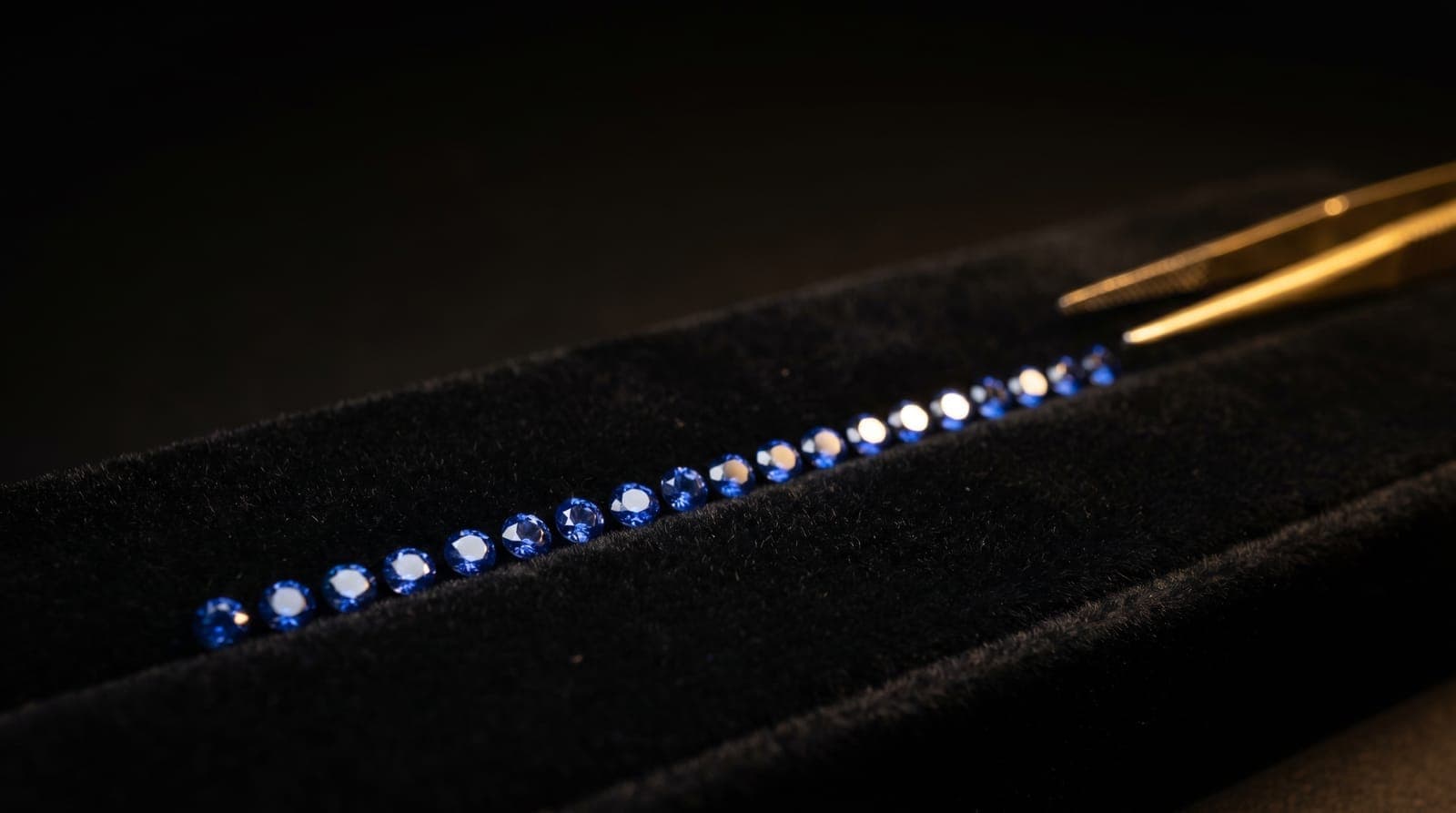
Calibrated stones — cut to precise millimeter dimensions for setting into production jewelry — are almost always sold by the parcel. The minimum is typically expressed as a carat weight or a piece count per size.
Rough guideline for sapphires and rubies:
- 2-3mm rounds: 5-10 ct per size as a typical small-parcel MOQ.
- 4-5mm rounds: 3-5 ct per size, or 10-20 pieces.
- 6mm+ rounds and ovals: 5-10 pieces as a typical parcel.
- Fancy shapes (princess, baguette, marquise): parcel sizes vary more, often 10-20 pieces per size.
The key detail: these minimums are per size, not per order. A jewelry manufacturer spec'ing a collection in 3mm, 4mm, and 5mm rounds is looking at a minimum across three separate sub-parcels. For more on calibration and why tolerances matter, see our gemstone calibration guide.
Melee for pavé work
Very small stones — typically under 2.5mm — used for pavé and accent settings are sold in higher volumes. Minimum parcels of 50+ carats are common, because the per-stone value is low and the sorting/matching labor has to be spread across a larger count to be economic.
For buyers who only need small quantities of melee for specific pieces, mixed-size melee parcels are a practical alternative — you accept a range of sizes (e.g., 1.5-2.3mm) rather than insisting on a single exact size.
Custom-cut orders
When a buyer commissions the factory to cut from specific rough, or to a specific non-standard shape, the economics shift from parcel-based to piece-based with setup overhead.
Typical structure:
- Custom cutting from client-supplied rough: minimums expressed as piece count, often 5-10 pieces per size/shape.
- Custom cutting from factory rough: minimums are more flexible — could be a single statement stone or a small run.
- Specialty cuts (Portuguese, concave, checkerboard): piece-count minimums apply because the cutter has to dedicate time to the specific technique.
For details on how we handle custom work, see our precision cutting service and custom sourcing pages.
What's Negotiable, What's Not
Experienced buyers understand which parts of an MOQ are structural and which are flexible.
Not negotiable (or rarely):
- Per-size calibration minimums. A factory running a 4mm round setup for your order has to cut enough pieces to justify the setup, no matter how much the buyer wants just five stones.
- Rough acquisition thresholds. If you need a specific origin or specific quality grade, the factory has to source rough that yields that material. Below a certain order size, the cost of rough selection outweighs the margin on a tiny parcel.
- Lab certification cost floors. If you want individual stones certified by GIA, AIGS, or GIT, each certificate has a fixed fee. Below a certain stone value, certification becomes a meaningful percentage of the order cost.
Usually negotiable:
- First-order trial size. Most factory-direct suppliers accept smaller-than-standard first orders. The supplier wants to evaluate the buyer too, and a trial parcel serves both sides.
- Mixed-lot parcels. Rather than hitting MOQ on a single category, buyers can often combine multiple categories (e.g., sapphires + rubies + spinels) into a single order to reach a viable total.
- Split shipments. Large orders can sometimes be staged — the factory commits to production, but ships in tranches as the buyer's cash flow allows.
- Payment structure. Deposit percentages, balance timing, and payment method are all routinely discussed, especially for repeat customers.
- Inclusion of test material. First orders sometimes include a small number of sample stones from related categories at no extra cost, so the buyer can evaluate future lines.
The general rule: fixed costs from the factory's side are hard to move. Commercial terms on the buyer's side are soft.
How We Structure Minimums at Authentic Gemstone
We try to keep our MOQ structure transparent and practical rather than defensive.
- Single statement stones: we sell from 1 carat, one piece at a time, across sapphires, rubies, and specialty colored gems.
- Calibrated lots: minimums start at approximately 5 carats per size for small rounds (2-3mm range) and scale with stone size. Exact minimums depend on the specific size and quality grade — we quote them up front when we quote pricing.
- Custom cutting: minimums are set per project. A single custom-cut statement stone is viable; a production run of custom calibrated sizes follows calibration MOQ logic.
- No minimum dollar threshold on first orders: we don't require buyers to hit a fixed dollar figure to place a first order. If the product-type minimum is met, the order is viable.
- Trial orders welcomed: we explicitly invite trial purchases from buyers evaluating us as a long-term supplier. A trial might be a single statement stone or a small calibrated parcel.
- Mixed first orders: we're happy to combine categories on a first purchase — a few sapphires, a small ruby parcel, and a sample of spinel, for example — so that the buyer can evaluate multiple lines from one order.
This is deliberate. We'd rather onboard a serious buyer with a small first order and grow the relationship over time than push them into an uncomfortably large commitment before they've seen our goods.
The Sample Order Strategy
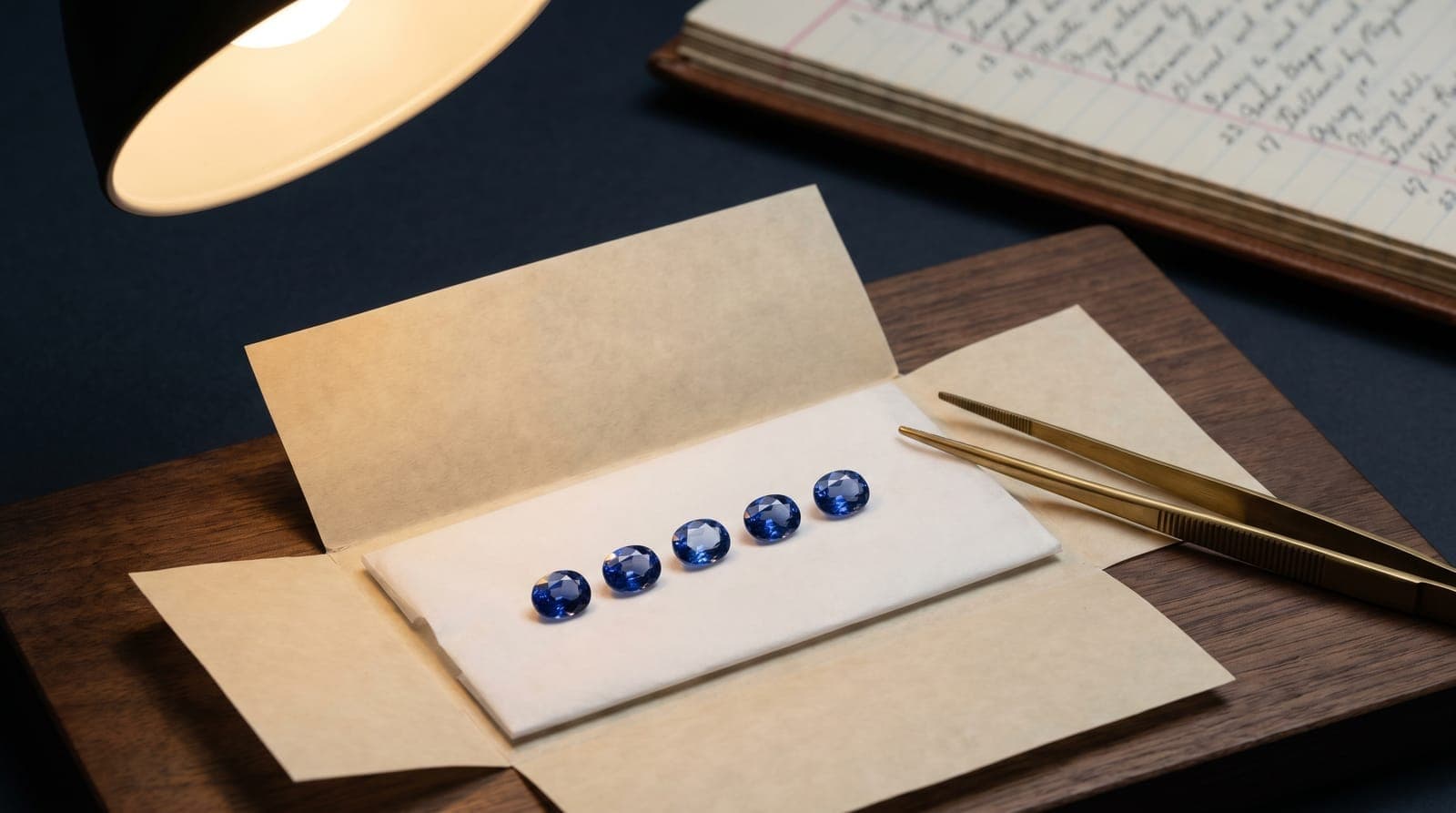
For buyers new to Bangkok or new to a specific supplier, a structured trial purchase is the single most useful step before committing to a production order.
How to request a trial parcel
A good trial request is specific, not open-ended. Suppliers respond better when you give them clear parameters:
- Name the stone type, variety, and approximate quality tier. "Commercial-grade blue sapphire, medium tone, medium saturation, heated" is actionable. "Nice sapphires" is not.
- Specify size or size range. Either a calibrated size (e.g., 4mm round) or a statement-stone weight range (e.g., 1.5-2.5 ct).
- State quantity clearly. "One 2 ct blue sapphire" or "a 5 ct parcel of 3mm rounds" — not "a few stones to look at."
- Confirm treatment expectations. Heated, unheated, or treatment-agnostic. This is essential for honest pricing.
- Clarify certification needs. If you want a lab report, specify the lab (GIA, AIGS, or GIT) and factor in the extra lead time.
Typical costs
Trial parcels are priced at standard wholesale rates. Suppliers are not giving product away — the "sample" concept here refers to the small order size, not a discount. Expect to pay full wholesale, which is still meaningfully below retail or broker pricing.
Shipping and insurance on small parcels is a real cost, often $40-100 via express courier. On a small trial order this is a larger percentage of total cost than it would be on a production order. That's normal.
What sellers expect in return
The implicit deal on a trial order is: you evaluate seriously, you give clear feedback, and if the material works for you, you come back with a larger order. Suppliers who invest time in trial parcels for buyers who vanish are not being rewarded for it.
If the trial material doesn't meet your standards, say so specifically — color not matching the tone you wanted, calibration out of tolerance, clarity below what you expected. Constructive feedback gives the supplier a chance to either address the issue or confirm that their offering isn't the right fit for your market. Both outcomes are useful.
For more context on the full sourcing cycle, see our guide on how to source gemstones from Thailand.
Red Flags on MOQs
A few supplier behaviors around MOQs should prompt caution.
Refusing to discuss minimums before showing pricing. Legitimate suppliers quote pricing and minimums together, because the two are coupled. A supplier who insists on collecting buyer information or pushing you toward a sales call before disclosing MOQ basics is often running a high-pressure model — not a factory-direct wholesale one.
Wildly inflated minimums relative to product type. If a supplier quotes a $50,000 minimum for 3mm commercial sapphires, something is off. Either the supplier is not actually a wholesaler (and is relying on brokerage margins), or they've decided you're not their target customer and the number is designed to filter you out. In either case, look elsewhere.
"Membership" fees or minimum annual commitments to access pricing. Legitimate B2B wholesale does not require upfront membership payments. These structures tend to show up in tiered-reseller or MLM-style models, not in factory-direct colored stone wholesale.
Demanding full payment before the buyer has seen stones. First-order deposit percentages are standard — often 30-50% — but full prepayment with no inspection step, no return privileges, and no independent verification option is a significant risk. For first orders especially, some form of inspection, video review, or third-party lab check should be possible. Our buying guide for sapphires covers the inspection step in more detail.
Vague or shifting minimums. MOQs should be stated in specifics (carats per size, pieces per parcel). A supplier whose "minimum" changes between conversations, or who communicates minimums only in loose dollar terms, is giving you a warning sign about how the rest of the transaction will run.
Ready to Discuss Your Order?
MOQs are the beginning of the conversation, not the end. The useful question is not "what's your minimum?" but "what's the minimum for the specific material I need, and how do we structure a trial order that makes sense for both of us?"
If you're evaluating suppliers for a new jewelry line, a production run, or a bespoke commission, we're happy to answer that question directly. Tell us the stone type, size range, and rough quantity you're considering, and we'll come back with pricing, minimums, and a trial-order structure — usually within 24 hours.
Frequently Asked Questions
What is the minimum order for wholesale sapphires?
There is no single industry-wide minimum. For calibrated sapphires, most Bangkok factories sell in parcels of 5-10 carats per size at the small end, and individual statement stones are typically available from 1 carat. Minimums scale with the size and quality tier of the material.
Can I order a single gemstone from a wholesaler?
Yes, for individual statement stones — 1 carat and above — most factory-direct wholesalers will sell one piece at a time. For calibrated melee and small rounds cut in production batches, suppliers typically sell by the parcel or by the size-set rather than piece-by-piece.
Do wholesalers offer sample orders?
Most reputable factory-direct suppliers accept trial orders. A sample purchase usually means a small calibrated parcel or a single statement stone sent for your inspection, priced at standard wholesale rates rather than discounted. Return privileges are sometimes offered for first-time buyers.
Is the MOQ negotiable?
Partly. Fixed setup costs — cutting a specific calibrated size from rough, for example — cannot be avoided. But trial parcel size, mixed-category lots, split shipments, and payment staging are all routinely negotiable, especially for first orders where the supplier is also evaluating you as a customer.
Key Takeaways
- There is no universal MOQ in colored stone wholesale — minimums depend on stone type, cut, size, and relationship stage.
- Statement stones (1 ct+) are typically available one piece at a time; calibrated parcels carry per-size minimums driven by cutting setup economics.
- Fixed production costs are structurally non-negotiable; commercial terms (trial size, mixed lots, payment staging) usually are.
- A well-specified trial order is the most efficient way to evaluate a new supplier before committing to production volume.
- Be cautious of suppliers who hide minimums, demand membership fees, or refuse any form of inspection before full payment.